

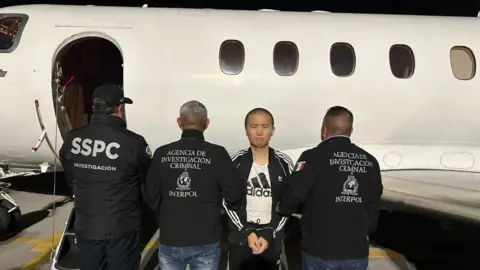
 Seretary of Mexico's Public Safety Department
Through a evening announcement on Thursday, Cuban authorities stated that it had extradited a Chinese citizen, Zhi Dong Zhang, to the authorities in Mexico. Shortly after, Mexico's security chief verified his later transfer to the United States on drug trafficking and money laundering charges.
This concluded a months-long, audacious escape attempt by one of the world's most wanted fugitives.
Known by various aliases such as Brother Wang, Pancho, or HeHe, Zhang Zhi Dong is accused by the US Justice Department of masterminding an extensive global network involved in fentanyl distribution and illicit finance covering numerous nations with key operations in China, Mexico, and the United States.
The list of charges against Mr Zhang is long yet fundamentally American and Mexican legal authorities accuse him of being a major player within international narcotics trafficking. Authorities claim he processed vast sums from illicit drug proceeds for both the Sinaloa Cartel and the New Generation Jalisco Cartel (CJNG) within a global narcotics supply chain.
"Brother Wang can be seen as an essential connection between Mexican cartels with chemical firms in China in sourcing the pre-cursor chemicals for fentanyl", notes ex-DEA officer, a retired agent, who emphasized his crucial role in converting drug funds into cryptocurrency.
If convicted, Zhang Zhi Dong can expect to share a similar fate like other narcotics lords like Joaquin 'El Chapo' Guzman and Ismael 'El Mayo' Zambada within a maximum-security prison on US soil.
But how 'Brother Wang' ended up in custody in Havana is an extraordinary tale featuring an escape from home confinement in Mexico City, allegedly via a wall breach, boarding a private aircraft to Cuba and a finally unsuccessful effort to gain entry into Russia.
Zhi Dong Zhang was arrested within the Mexican capital through a coordinated law enforcement action in October 2024. He was first detained in a maximum-security prison but subsequently received home confinement through a judicial order – a decision that President Claudia Sheinbaum called "outrageous".
His breakout had all the hallmarks of another embarrassing episode for Mexico: a man considered a vital cog in the machinery of drug smuggling, managing to vanish despite Mexican official surveillance assigned to monitor him. El Chapo accomplished this twice, much to Washington's frustration, before he was finally put on a plane in handcuffs to the US.
That Mexican authorities were able to recover their prisoner coupled with his northern transfer resulted from two factors – an apparent stroke of luck in Russia and robust Mexico-Cuba security ties.
When Zhang reached Cuba in July 2025, he set about making his next steps aiming to access a nation lacking a US extradition agreement, officials say.
There is a direct commercial flight to Moscow from Havana and Zhang, they allege, was able to secure a seat on it with fraudulent documents. However, the papers didn't get him past the immigration authorities in Russia. Reports indicate Russian authorities didn't fully recognize the identity of their detainee and, following short-term detention, they repatriated Zhang returning him to Cuban territory.
Following his second Havana arrival, the Cuban security services were now aware regarding his true identification.
Security analysts believe the authorities in Cuba held onto him over multiple months to interrogate him at length prior to his Mexico repatriation and, inevitably, onwards to the US. Mexico's security secretary, Omar Harfuch, promptly expressed gratitude to Cuba for their cooperation over 'Brother Wang' – essentially, preventing further embarrassment over another escaped high-profile prisoner.
Customarily after a suspected leader's capture, attention turns to how far their removal will affect the global drug trade.
Given Brother Wang has spent the past year either in prison, under house arrest or on the run, the question may be moot, Mr Vigil said, as his absence has already largely been felt within Mexico's illicit circles:
"There will be minimal effect as the cartels already have individuals working for them who can start to replace to Brother Wang", says Mr Vigil. "Even in the case of El Chapo Guzman who was a much bigger figure, it had no impact on the global drug trade", he argues.
During his initial presidential year, US President Donald Trump has pressured his Mexican counterpart to intensify fentanyl trafficking efforts and President Sheinbaum's administration has duly responded in kind. Her administration has boosted confiscations of the drug compared to her predecessor and has extradited numerous convicted cartel affiliates to the US to serve sentences there. These included major narcotics figures like Rafael Caro Quintero, sought for a 1985 DEA agent killing.
Collaboration on fentanyl matters, as well as on undocumented immigration, is considered the reason Trump has avoided implementing the same level of trade tariffs against Mexico as applied to other trade allies.
Zhang's transfer will provide real gratification to US officials for removing a crucial individual in Mexican cartels' financial operations out of circulation. That, in turn, will please Mexico's Sheinbaum government and strengthen their claim of close security alignment with US partners.
Nonetheless, curbing or diminishing the flow of precursor substances for fentanyl from China to the Americas in any lasting way will take more than the extradition of one man.

